
Casinos make money on approximately 99.7% of operating days. That's not a typo. The American Gaming Association tracks this stuff, and the consistency is almost unsettling when you think about it. Meanwhile, most consulting firms I've worked with over the past two decades treat risk assessment like an afterthought—something you slap into a proposal to look thorough.
There's a disconnect here that's worth exploring.
Why casinos rarely lose money
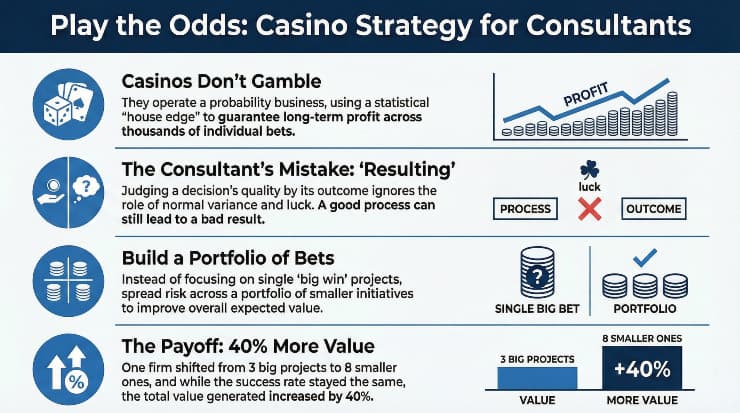
The house doesn't gamble. That's the fundamental insight most business professionals miss. Casinos aren't in the gambling business—they're in the probability business. Every game, every slot machine, every blackjack table operates on precisely calculated expected values.
And here's what makes it interesting for consultants: casinos don't try to win every hand. They're perfectly comfortable losing individual bets because they've engineered the overall system to produce reliable outcomes over time.
The math behind house edge
House edge is simply the statistical advantage built into every game. Roulette gives the house about 5.26% on American wheels. Blackjack, played well, drops that to around 0.5%. The 6 Jokers slot operates on similar principles—designers calibrate volatility and return-to-player percentages to balance player excitement with predictable long-term returns.
The critical point? Casinos know their numbers before they open the doors.
Most consulting engagements I've seen don't come close to this level of probabilistic rigor. We estimate, we forecast, we build financial models. But we rarely think in terms of expected value across hundreds or thousands of decisions.
What consultants get wrong about risk
Annie Duke, former professional poker player and decision strategist, puts it well: "Resulting—judging decisions by their outcomes rather than by their process—is one of the biggest obstacles to improving our decision-making."
That quote should probably be tattooed somewhere visible for every strategy consultant.
Confusing variance with bad strategy
Here's a scenario I've seen play out maybe a dozen times. A firm recommends a market entry strategy with solid fundamentals. The client executes it properly. Results come back mediocre. Everyone concludes the strategy was wrong.
But was it? Or did normal variance just produce an outcome on the lower end of the probability distribution?
Casinos understand this intuitively. A player hitting a $50,000 jackpot doesn't make management question their business model. It's an expected outcome within a known distribution. Consultants, though, tend to panic when individual projects underperform—even when the overall portfolio performs exactly as probability would predict.
Building a probability-based framework
So how do you actually apply casino risk management principles to consulting work? It's not as complicated as it sounds, but it does require some mental rewiring.
Here are the key principles consultants can borrow from casino risk models:
- Calculate expected value for decisions, not just best-case scenarios
- Accept that individual outcomes will vary wildly from expectations
- Build portfolios of decisions rather than betting everything on single recommendations
- Track decision quality separately from outcome quality
- Set position limits (how much you're willing to lose on any single initiative)
The portfolio thinking is probably the most underutilized concept. Casinos don't offer just one game. They spread risk across thousands of independent probability events happening simultaneously.
Steps to implement this thinking
- Identify recurring decision types in your practice—project selection, pricing, resource allocation, client recommendations
- Calculate rough expected values for each decision type using historical data from your firm
- Track outcomes over time to refine your probability estimates (most firms skip this entirely)
- Adjust position sizing based on variance—high-variance decisions get smaller allocations
A manufacturing client I worked with applied this approach to their R&D pipeline. Instead of funding three big projects annually, they restructured to fund eight smaller ones with clearer probability assessments. Three years later, their success rate hadn't changed much—still about 25% of projects hit targets. But total value generated increased by roughly 40% because they'd reduced their exposure to any single failure.
Risk-reward across different contexts
Not every situation calls for casino-style thinking. That's worth acknowledging directly.
| Decision Type | Risk Level | Expected Return | Variance | Time Horizon |
| Casino table game | Medium | -2% to -5% | High | Minutes |
| Slot machine | Medium-High | -4% to -15% | Very High | Minutes |
| Consulting project bid | Medium | +15% to +40% | Medium | Months |
| Strategic acquisition | High | +5% to +200% | Very High | Years |
| Process optimization | Low | +8% to +20% | Low | Months |
The table above shows something important. Casino games actually have pretty predictable outcomes despite high session-to-session variance. Consulting projects have lower variance but longer feedback loops. Strategic acquisitions? They're kind of a mess probabilistically (which is why most M&A destroys value statistically).
When casino thinking applies well
- Decisions that repeat frequently with similar structures
- Situations where you can gather meaningful sample sizes
- Choices where expected value calculations are possible with reasonable accuracy
- Portfolio contexts where individual losses are survivable
When it probably doesn't help much
- One-time strategic decisions with unique characteristics
- Situations dominated by unknown unknowns rather than calculable risks
- Contexts where relationships and trust matter more than optimization
- Decisions where being "approximately right" isn't good enough
The Investopedia guide on risk-reward ratios covers some additional nuances worth understanding, particularly around position sizing in investment contexts.
The limits of this model
I should be honest about something. Casino risk reward models work because casinos control the environment completely. They set the rules, define the payouts, and remove anything that doesn't fit their probability framework.
Consulting doesn't work that way.
Clients change their minds. Markets shift unexpectedly. Competitors do unpredictable things. The variables you can't control often matter more than the ones you can.
Plus, there's a human element that pure expected value calculations miss. A client might rationally prefer a lower expected value option because it reduces anxiety, preserves relationships, or aligns with their values. That's not irrational—it's just optimizing for something beyond financial return.
Still, the core insight holds. Thinking probabilistically, tracking decision quality over time, and building portfolios of choices rather than making isolated bets—these habits improve outcomes whether you're running a casino floor or advising a Fortune 500 board.
The math works. But only if you actually use it.